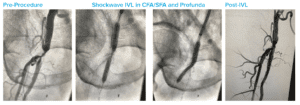
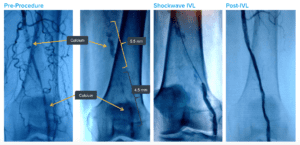
Case submitted by Roger Gammon, MD, Heart Hospital of Austin

Summary: Extensive trifurcation calcification involving anterior tibial and tibioperoneal trunk. Multiple previous failed interventions. Prior to Shockwave IVL, multiple failed percutaneous transluminal angioplasty (PTA) and cutting balloons used in the same procedure. 4.0 mm x 60 mm Shockwave IVL delivered across PT ostium and three cycles delivered. Same catheter moved to AT ostium and three cycles delivered. Final result shows resolution of stenosis and good flow.

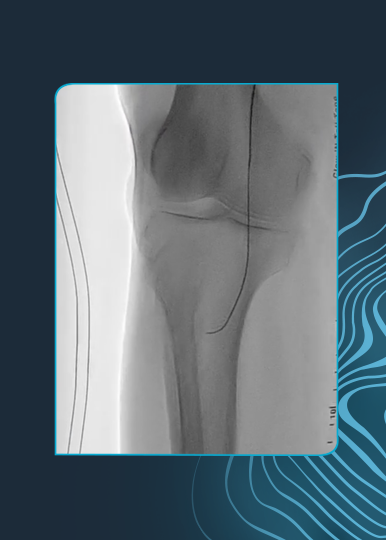
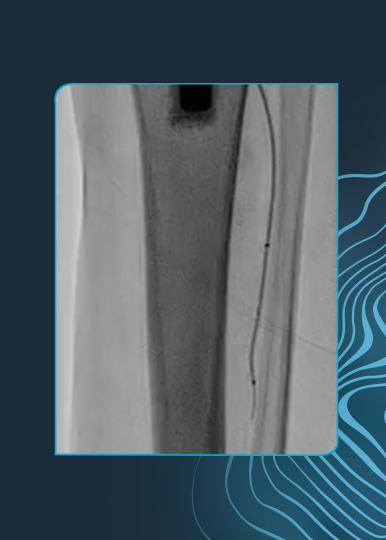
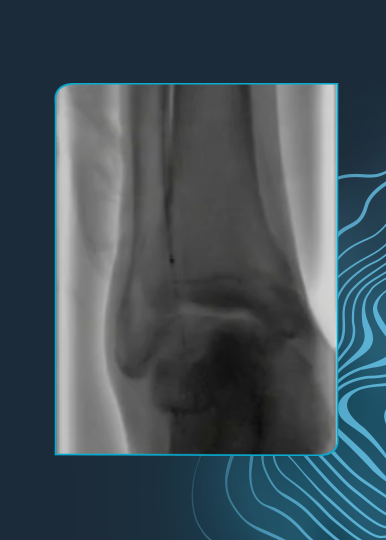
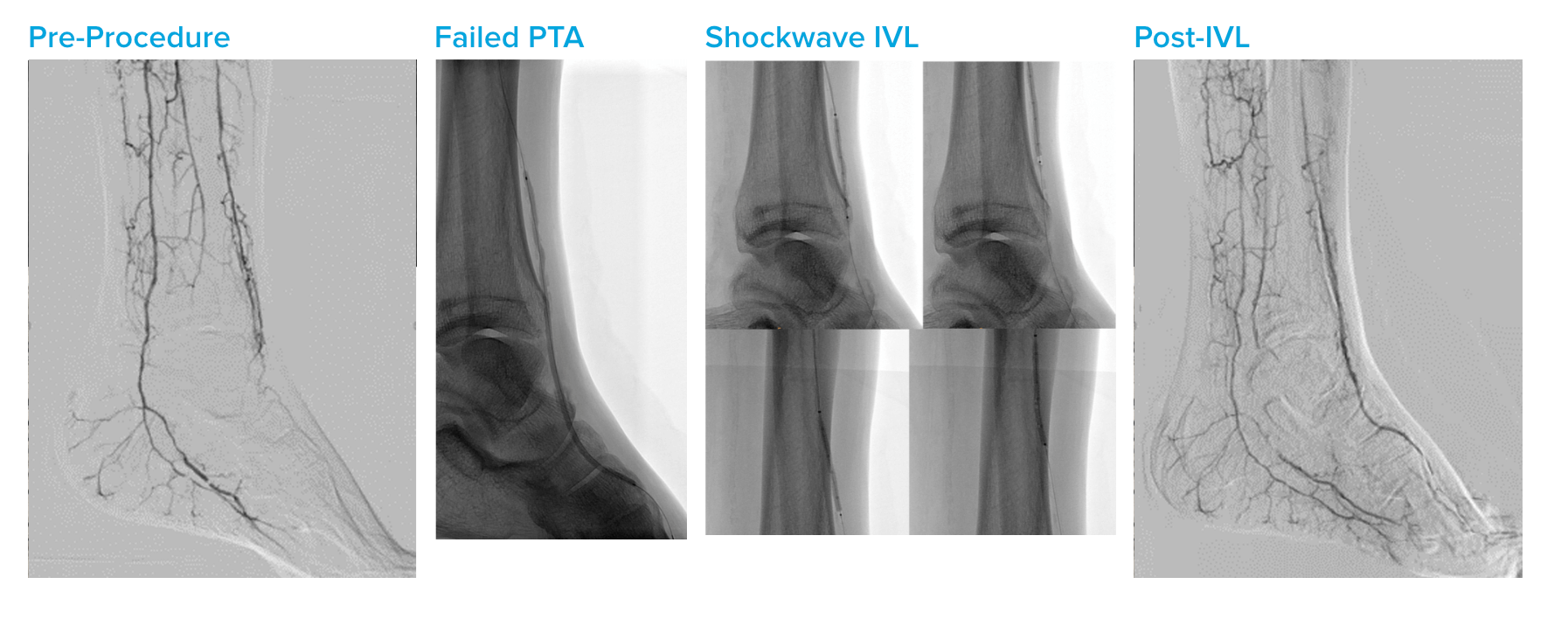
Case submitted by Roberto Ferraresi, MD, Humanitas Gavazzeni

Summary: CLTI patient (Rutherford 5) with foot ulceration. Diagnostic angiogram shows near-occlusion of distal AT. 2.5 mm percutaneous transluminal angioplasty (PTA) of AT and dorsalis pedia attempted with near-immediate recoil and unsatisfactory result. 2.5 mm x 40 mm Shockwave IVL introduced into distal AT. Post-IVL angiogram shows resolution of stenosis with good distal flow into dorsalis pedis and no complications.

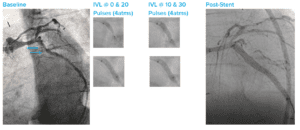
Case submitted by Jean Fajadet and Bruno Farah, Clinique Pasteur

Summary: Severely calcified distal left main and proximal left anterior descending (LAD) lesion; operators were hesitant to use rota; Shockwave IVL advanced with no pre-dilation required; 3.5 x12 mm IVL treatment performed and balloon waist resolved after 20 pulses; final result of widely patent artery with TIMI 3 flow post-stent (3.5 mm) with 4.5 mm NC post-dil.

Case submitted by Javier Escaned, San Carlos Hospital

Summary: Severely calcified mid-left anterior descending artery (LAD) involving septal branch; patient was high-bleeding risk and IABP used for hemodynamic support; operators wanted to avoid distal embolization for this patient and chose Shockwave IVL; 3.0 mm IVL catheter used across diffuse calcified disease; significant fractures seen under OCT in multiple planes; circumferential and well-apposed 3.0 x 32 mm drug-eluting stent (DES).

Case submitted by Javier Escaned, San Carlos Hospital

Summary: Highly angulated left circumflex artery (LCX) with lesions proximal and distal; OCT wouldn’t cross either lesion; guideliner-assisted Shockwave IVL catheter delivery followed by successful IVL therapy; the case was completed with easy deployment of two long drug-eluting stents (DES).

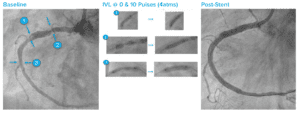
Case submitted by Jonathan Hill, King’s College

Summary: Multi-lesion right coronary artery (RCA); couldn’t advance guideliner to distal lesion despite predilation; advanced 3.5 mm Shockwave IVL catheter as far as possible (1); delivered one cycle (10 pulses) and vessel opened; pulled back to the ostium (2) and vessel opened after one cycle (10 pulses); advanced to distal lesion (3) and vessel opened after one cycle (10 pulses); easily delivered 80 mm of drug-eluting stent (DES).

Case submitted by Antonio Colombo, San Raffaele

Summary: Large eccentric lesion at left circumflex (LCX) ostium; delivered four cycles with 3.5 mm Shockwave IVL catheter; full balloon expansion (and associated lower endoflator pressure) were noted; verified treatment response using a non-compliant balloon; then used the same IVL device to successfully treat the left main (LM).

Case submitted by Jonathan Hill, King’s College

Summary: Unprotected left main (LM) trifurcation with heavy calcium throughout LM, left anterior descending artery (LAD), left circumflex artery (LCX), and at ostia of trifurcation; hemodynamic support with temporary pump; Shockwave IVL administered along LAD, LCX, LM and at the ostia of LCX, LAD, and Ramus; drug-eluting stents (DES) placed in LM and all three vessels with good expansion and apposition (demonstrated with OCT).

Case submitted by Brian Kolski, MD, St. Joseph Hospital

Summary: 85-year-old woman with critical aortic stenosis and severe rest pain. Not a surgical candidate due to lung disease. Calcified near-occlusion of distal aorta and no transcaval or subclavian access option available. 7.0 mm x 60 mm Shockwave IVL delivered to bilateral iliac arteries. Post-IVL safe passage of a 26 mm Medtronic Evolut R TAVR/TAVI device followed by endovascular femoral repair. Patient discharged the following day.

Case submitted by David Caparrelli, MD, Catholic Medical Center

Summary: Pre-procedure angiogram shows extensive calcification and tight stenoses distal to existing AAA graft. 7.0 x 60 mm Shockwave IVL delivered to left iliac artery. Post-IVL angiogram demonstrates suitable access diameter. 24 Fr Medtronic Valiant TEVAR graft safely delivered and deployed through iliac artery with no complications.