
DISRUPT BTK II
Count on it: New data confirms Shockwave Intravascular Lithotripsy’s (IVL) impact below the knee (BTK): Acute, 30-day, 6-month and 12-month outcomes in the global prospective, multi-center, single-arm IVL study assessing the safety and effectiveness of the Shockwave peripheral IVL system for the treatment of calcified, stenotic BTK lesions.


Full Cohort Key Findings
-
Limb Preservation
The 12-month outcomes confirm the durability of IVL in complex BTK anatomy through sustained vessel patency and low reintervention rates which lead to limb preservation and ongoing symptom relief. -
Safety & Effectiveness
At 12 months, IVL continues to demonstrate a strong safety profile and consistent effectiveness in high-risk patients with challenging calcium BTK. -
Frontline BTK Strategy
The DISRUPT BTK II 12-month data establishes IVL as a frontline calcium modification strategy* for complex BTK lesions, delivering outcomes that redefine the benchmark for success in the treatment of patients with chronic limb-threatening ischemia (CLTI).
*Frontline Strategy: The approach of utilizing IVL as the primary treatment method, implemented without the use of atherectomy. This strategy is backed by the BTK II data based on the percentage of procedures involving pre-dilatation and post-dilatation, as well as the proportion of stenting performed. Our BTK II data indicates a notably low usage of both pre-dilatation and post-stenting in these cases.
Armstrong E, VIVA 2025
Study Leadership
This section contains attributions including profile pictures, titles, descriptions, and Twitter handles.
-
Venita Chandra, MDClinical Associate Professor of Surgery, Associate Program Director – Vascular Surgery, Medical Director Stanford Advanced Wound Center
-
Ehrin Armstrong, MDMedical Director, Aurora Denver Cardiology Associates, Swedish Medical Center
DISRUPT BTK II Study Design
Objective
Assess the continued safety and effectiveness of the Shockwave Medical peripheral IVL system for the treatment of calcified, stenotic lesions in BTK arteries. Products included Shockwave M5+ and Shockwave S4
Key Inclusion Criteria
- Rutherford classification (RC) 3-5, RC 3 capped at 20% of enrolled patients
- Moderate-severe calcification*
- Up to two BTK lesions ≤ 200 mm in length
Primary Safety Endpoint
Major adverse limb events (MALE) or post-operative death (POD) at 30-days
Primary Effectiveness Endpoint
Procedural success, defined as ≤ 50% residual stenosis for all treated target lesions without serious angiographic complications
Additional analysis to include lesions with ≤ 30% residual stenosis without angiographic complications
Independent Clinical Events Committee (CEC), Angiographic Core Laboratory, and Duplex Ultrasound Core Laboratory
Study cohort represents complex patients with challenging calcified lesions below the knee
Results validate Shockwave IVL as a safe and effective treatment for challenging calcific below-the-knee lesions with minimal need for provisional stenting
* Presence of fluoroscopic evidence of calcification by PARC (Peripheral Academic Research Consortium) definition: 1) on parallel sides of the vessel and 2) extending > 50% the length of the lesion if lesion is ≥ 50 mm in length; or extending for minimum of 20 mm if lesion is < 50 mm in length.
By the Numbers
Statistics Callout
This section presents key statistical information with numbers and descriptions.
-
250Patients
-
305Lesions
-
38Global sites
-
2Year follow-up
Full Cohort Baseline Demographics
The DISRUPT BTK II study enrolled the largest cohort of real-world, complex patients* with moderate to severe calcium below the knee; no other technology has been evaluated in such severely calcified BTK lesions to date. BTK II sets a new benchmark for what’s possible for these challenging lesions.
*The majority of patients enrolled had CLTI, thus a majority of the comorbidities are attributed to this population.
Medical History
Statistics Callout
This section presents key statistical information with numbers and descriptions.
-
58.5%Patients had wounds at baseline
-
15%Hemodialysis-dependent
-
70%Diabetes mellitus
Rutherford Category
Statistics Callout
This section presents key statistical information with numbers and descriptions.
-
57%RC 5, minor tissue loss, CLTI
-
23%RC 4, ischemic rest pain, CLTI
-
20%RC 3, severe claudication*
Lesions
Statistics Callout
This section presents key statistical information with numbers and descriptions.
-
85%Moderate-severe calcification†
-
91 mmMean calcified length
-
30%Chronic total occlusions
*Enrollment of RC3 was capped at 20% | †PARC Definition
Armstrong E, VIVA 2025
IVL’s Safety Profile Confirmed in Challenging Calcium Below the Knee
IVL was confirmed to be a safe treatment option in a challenging patient and lesion cohort.
STRONG SAFETY PROFILE
| Post-IVL | Final | |
| N | 268 lesions | 290 lesions |
| Any serious angiographic complication (total) | 1.9% (5/268) | 1.0% (3/290) |
| Dissection (Type D-F) | 0.7% (2/268) | 0.3% (1/290) |
| Total perforations | 1.5% (4/268) | 0.7% (2/290) |
| Distal embolization1 | 0% (0/268) | 0% (0/290) |
| Slow flow/no reflow2 | 0% (0/268) | 0% (0/290) |
| Abrupt closure | 0.4% (1/268) | 0.3% (1/290) |
| Thrombus | 0% (0/268) | 0% (0/290) |
Three patients with serious angiographic complications at final:
- One patient had one undiagnosed minor perforation (Grade I)
- One patient had a Grade II perforation seen pre-IVL balloon inflation, downgraded to Grade I after DES placement
- One patient experienced abrupt vessel closure despite DES placement for grade F dissection
None of the three patients had adverse events through discharge.
1: One patient had a distal thromboembolism post-IVL. Transluminal suction thrombectomy was performed and the event was successfully resolved although imaging was not provided to the core lab for assessment, therefore, data was not included in table.
2: No Reflow defined as reduced antegrade flow without evidence of residual stenosis or dissection at the treatment site.
Chandra V, Lansky AJ, Sayfo S, et al. Thirty-Day Outcomes from the Disrupt PAD BTK II Study of the Shockwave Intravascular Lithotripsy System for Treatment of Calcified Below-the-Knee Peripheral Arterial Disease. Journal of Vascular Surgery. Published online November 12, 2024. doi:10.1016/j.jvs.2024.11.003
IVL’s Effectiveness Confirmed in Challenging Calcium Below the Knee
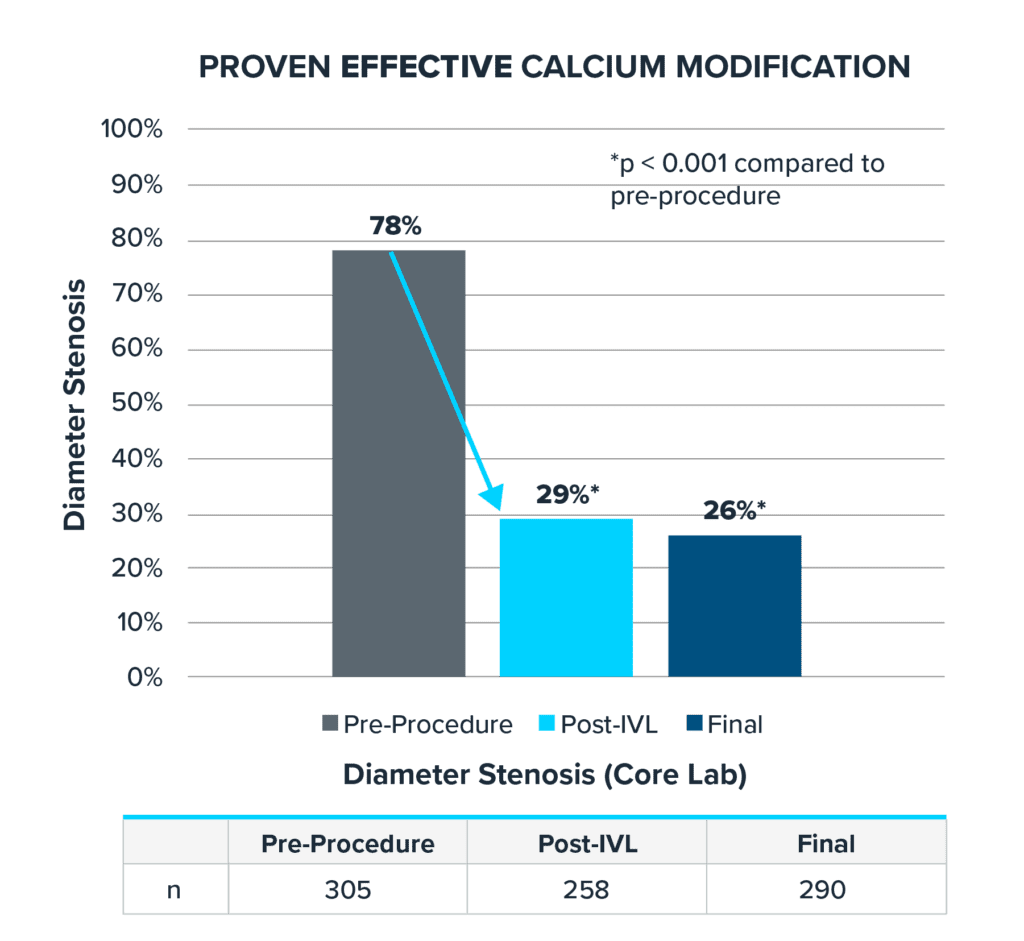
IVL was confirmed to be effective at reducing lesion stenosis with minimal additional treatment therapy.
Primary Effectiveness Endpoint
- Final residual stenosis of ≤ 50% without serious angiographic complications: 97.9% (232/237, 95% CI 95.1%-99.3%)
- Additional analysis: Final residual stenosis of ≤ 30% without serious angiographic complications: 74.1% (215/290, 95% CI 68.7%-79.1%)
Chandra V, Lansky AJ, Sayfo S, et al. Thirty-Day Outcomes from the Disrupt PAD BTK II Study of the Shockwave Intravascular Lithotripsy System for Treatment of Calcified Below-the-Knee Peripheral Arterial Disease. Journal of Vascular Surgery. Published online November 12, 2024. doi:10.1016/j.jvs.2024.11.003
Procedural Information
Statistics Callout
This section presents key statistical information with numbers and descriptions.
-
65%No pre-dilation
-
65%No post-dilation
-
4.9%Total stent/tack implant
-
2.3%Provisional stent/tack implant*
*Remaining stent/tack implants were part of physicians’ standard algorithm.
Chandra V, Lansky AJ, Sayfo S, et al. Thirty-Day Outcomes from the Disrupt PAD BTK II Study of the Shockwave Intravascular Lithotripsy System for Treatment of Calcified Below-the-Knee Peripheral Arterial Disease. Journal of Vascular Surgery. Published online November 12, 2024. doi:10.1016/j.jvs.2024.11.003
Primary Safety Endpoint at 30-Days
Results for the primary safety endpoint at 30-days further confirm IVL’s safety and ongoing efficacy in challenging calcium below the knee.
| Measure | Rate | 95% CI |
| Major Adverse Limb Events (MALE) or Post-Operative Death (POD) | 0.8% (2/242) | 0.1% – 3.0% |
| All-cause death | 0.0% (0/242) | 0.0% – 1.5% |
| Above-ankle amputation of the index limb | 0.8% (2/242) | 0.1% – 3.0% |
| Major reintervention | 0.0% (0/242) | 0.0% – 1.5% |
Two patients required above-ankle amputations of the index limb:
- One patient had worsening necrotizing fasciitis of the right foot and underwent amputation nine days after index procedure
- One patient had non healing wounds in multiple areas of the foot and had an amputation nine days after index procedure
These events were reported as not related to the study device or procedure and the decision to amputate was made on clinical grounds by the treating physician.
Chandra V, Lansky AJ, Sayfo S, et al. Thirty-Day Outcomes from the Disrupt PAD BTK II Study of the Shockwave Intravascular Lithotripsy System for Treatment of Calcified Below-the-Knee Peripheral Arterial Disease. Journal of Vascular Surgery. Published online November 12, 2024. doi:10.1016/j.jvs.2024.11.003
Freedom from CD-TLR and Patency at 12 Months
12-month outcomes confirm the durability of IVL through sustained vessel patency and low reintervention rates which lead to limb preservation and ongoing symptom relief.
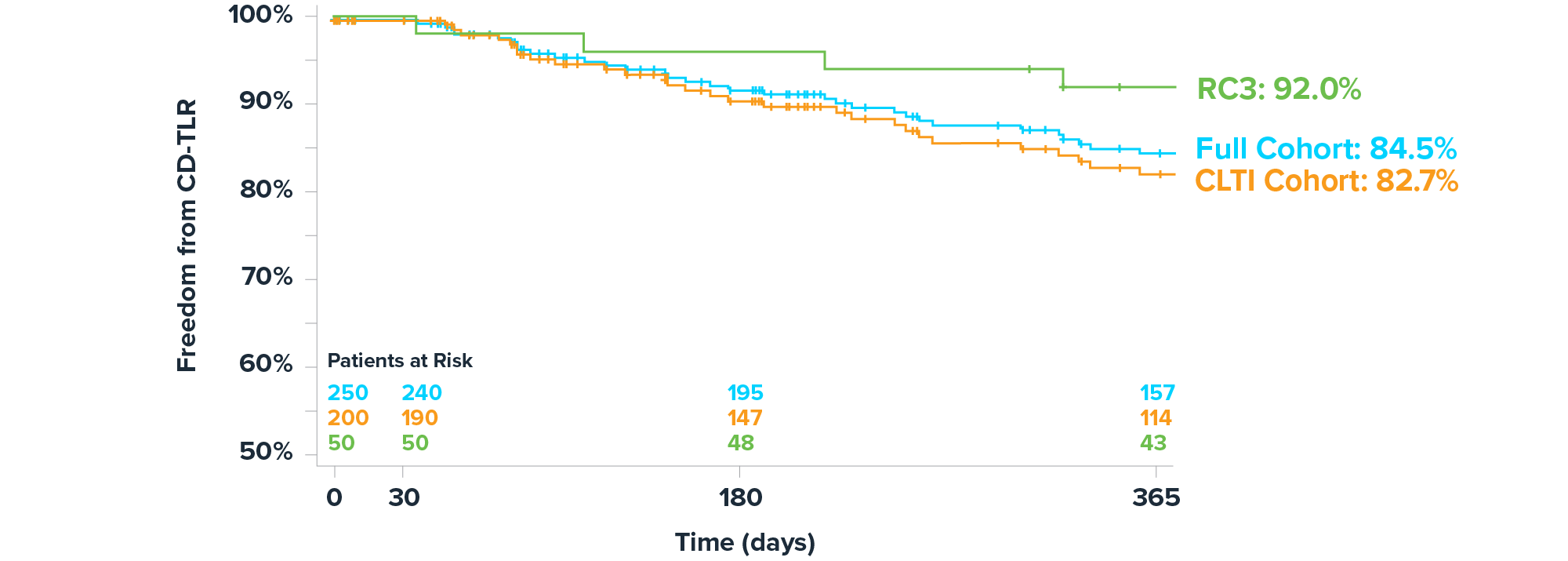
| Rutherford Category | Freedom from CD-TLR at 12 Months |
| Full Cohort (n=250) | 84.5% |
| RC 3 (n=50) | 92.0% |
| CLTI (n=200) | 82.7% |
| Patency at 12 Months | |
| 67.1% (94/140) | |
Armstrong E, VIVA 2025 | Clinically driven target revascularization (CD-TLR). | Kaplan Meier (KM) is an analysis that uses probability to capture patients lost to follow-up. | Freedom from CD-TLR analysis excluded patients with above the ankle amputation of target limb.
Freedom from Major Amputation at 12 Months
12-month outcomes establish IVL’s role in limb salvage and enabling functional recovery.
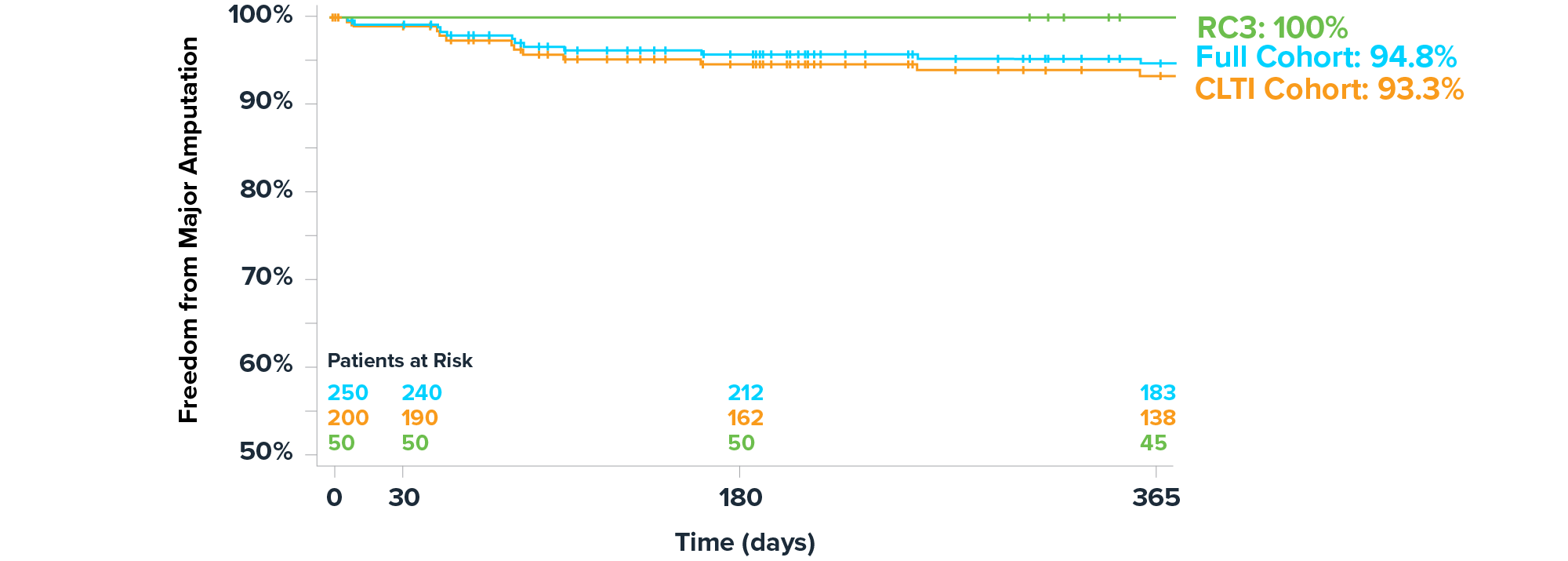
| Rutherford Category | Freedom from Amputation at 12 Months |
| Full Cohort (n=250) | 94.8% |
| RC 3 (n=50) | 100% |
| CLTI (n=200) | 93.3% |
Armstrong E, VIVA 2025 | Kaplan Meier (KM) is an analysis that uses probability to capture patients lost to follow-up.
Rutherford Classification at 12 Months
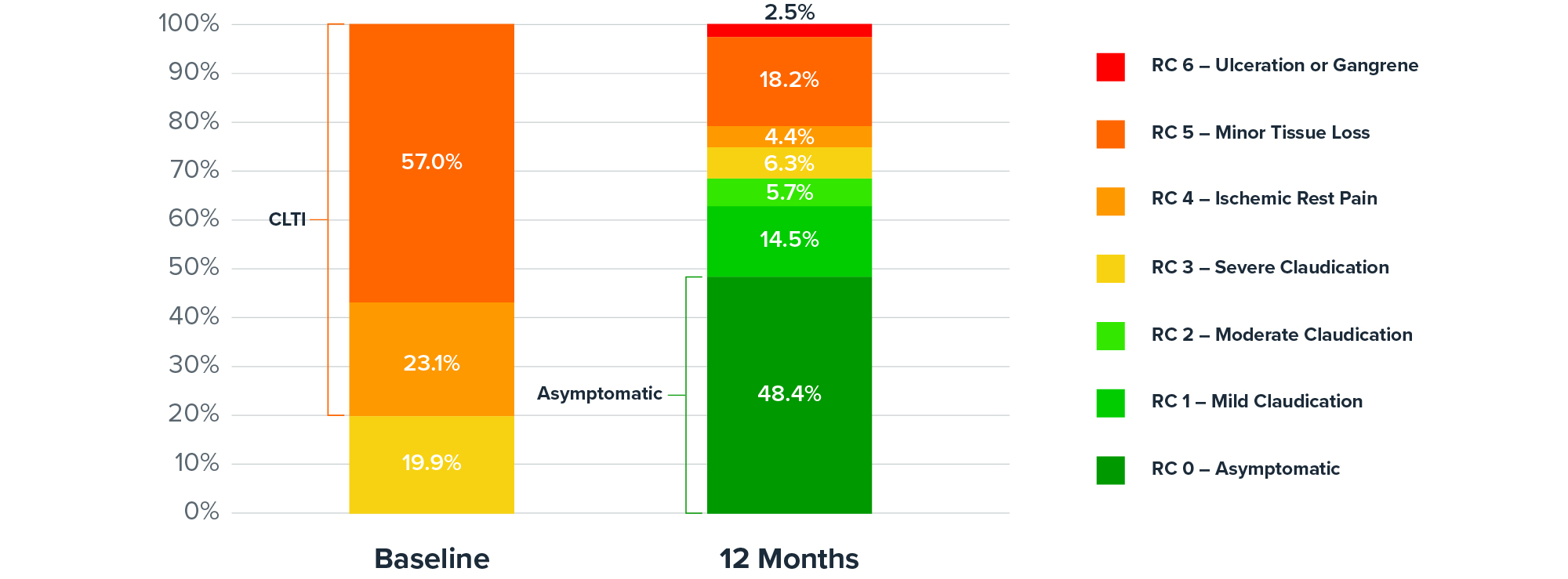
In a majority of patients with CLTI, IVL plays a critical role in laying the foundation for successful wound healing through safe and effective revascularization
- At baseline, 80% of patients experienced CLTI which improved to just 25.1% in patients with available 12-months follow-up
- 61% of wounds were healed or improving*
Armstrong E, VIVA 2025
*Mean Wound Follow Up Time: 157 days
Available data at 12 months is 159 limbs out of 251 limbs.
Quality of Life (QoL) at 12 Months
As part of revascularization, IVL facilitates sustained symptom improvement through 12 months.
| VascuQoL-6 Attribute | Activity | Tired | Walk | Concern | Social | Pain |
| Average Score 12 Months (RC 3) |
3.1 | 2.8 | 3.1 | 3.2 | 3.4 | 2.9 |
| Average Score 12 Months (CLTI) |
2.8 | 2.6 | 3.0 | 2.9 | 3.1 | 2.8 |
| Average Score Baseline (RC 3) |
1.9 | 2.0 | 2.3 | 2.1 | 2.6 | 1.9 |
| Average Score Baseline (CLTI) |
1.9 | 2.0 | 2.3 | 1.7 | 2.3 | 1.8 |
- All categories improved. Total VascuQoL-6 Score for both RC 3 and CLTI at 12 months significantly improved from baseline (P-Value: p<0.001).
- RC 3: Total at 12 months was 18.5 ± 4.7 and total at baseline was 12.9 ± 3.8.
- CLTI: Total at 12 months was 17.2 ± 5.0 and total at baseline was 11.9 ± 4.0.
Armstrong E, VIVA 2025 | The Vascular Quality of Life Questionnaire is a survey used to determine health related quality of life (HRQoL) in patients with peripheral arterial disease (PAD). Each attribute is scored 1-4, a higher value indicates better health status. The sum of each individual attribute score is used to generate a total quality of life score
-

DISRUPT BTK II Acute Outcomes: Physician Perspectives with Dr. Lakshminarayan & Prof. Holden
-
DISRUPT BTK II Acute & 30-Day Outcomes with Dr. Venita Chandra and Dr. Ehrin Armstrong
More Shockwave Peripheral IVL Studies
-
Post-market, European study to assess the safety and performance of Shockwave IVL as a standalone therapy in heavily calcified infrapopliteal lesions out to 30 days.Peripheral IVL
-
The largest-ever randomized clinical study of Shockwave peripheral IVL treatment in severely calcified peripheral lesions, out to 24 months.Peripheral IVL
-
The largest prospective real-world evidence for the treatment of complex, heavily calcified peripheral arterial disease (PAD).Peripheral IVL
Chandra V, Lansky AJ, Sayfo S, et al. Thirty-Day Outcomes from the Disrupt PAD BTK II Study of the Shockwave Intravascular Lithotripsy System for Treatment of Calcified Below-the-Knee Peripheral Arterial Disease. Journal of Vascular Surgery. Published online November 12, 2024. doi:10.1016/j.jvs.2024.11.003